Google Search Engine Optimization (SEO)-The Key to Higher Rankings
Google Search Engine Optimization (Google SEO) is the process of improving your site so it can rank higher in Google Search results. The goal of SEO is to increase your site’s visibility, traffic, and chances of getting clicks whenever someone searches for information related to your content or business. This entire process is often referred to as search engine optimization.
Why Google SEO Matters for Engine Rankings and Visibility
Google is the world’s most-used search engine, so achieving higher engine rankings means:
- More website visitors (organic traffic is free).
- More leads and sales for your marketing.
- More brand visibility and authority.
- Better trust and long-term stability.
Understanding your audience’s search intent is one of the most important factors in modern Google Search success.
Key Pillars of SEO Optimization: On-Page, Off-Page, and Technical SEO
Google Search Engine Optimization has three main components that contribute to successful seo optimization and better seo rankings:
1. On-Page SEO (Content Optimization)
On-Page SEO focuses on optimizing the content and HTML elements on your site. Key elements for SEO optimization include:
- Strategic use of Google keyword (like a target keyword) throughout the content.
- Optimizing the page title and meta descriptions.
- Structuring the content using headings (H1,H2, H3)
- Internal linking to other relevant pages on your site.
- Ensuring the content matches the search intent of the user.
2. Off-Page SEO (Authority and Trust)
Off-Page SEO is about improving your website’s reputation externally. These external factors are crucial for demonstrating trust to the search engine:
- Backlinks: High-quality links from other authoritative search engines or sites.
- Social sharing and brand mentions.
- Local SEO (especially important for local businesses).
3. Technical SEO (Site Health)
Technical SEO focuses on improving the website’s infrastructure to ensure the search engine can easily crawl and index your site. This aspect directly affects user experience and engine rankings:
- Page speed and Core Web Vitals.
- Mobile friendliness.
- Sitemap and HTTPS security.
- Crawlability and accessibility for the Google bot.
How Google Decides SEO Rankings
Google and other search engines rank pages based on hundreds of complex factors (or signals) that determine your final seo rankings. The most critical factors include:
- Google keyword relevance and satisfying the user’s search intent.
- Content quality, reliability, and freshness.
- Backlinks and overall site authority.
- Page loading speed and mobile performance.
You can find many SEO certifications and resources online to learn these factors in depth, including free courses from major platforms.
Conclusion
Google Search Engine Optimization is the method of improving your site so it ranks higher in Google Search results. By mastering the three pillars—on-page seo, off-page seo, and technical seo—your site becomes more visible, attracts more visitors, and grows your online presence through consistent search engine optimization and improved seo rankings.
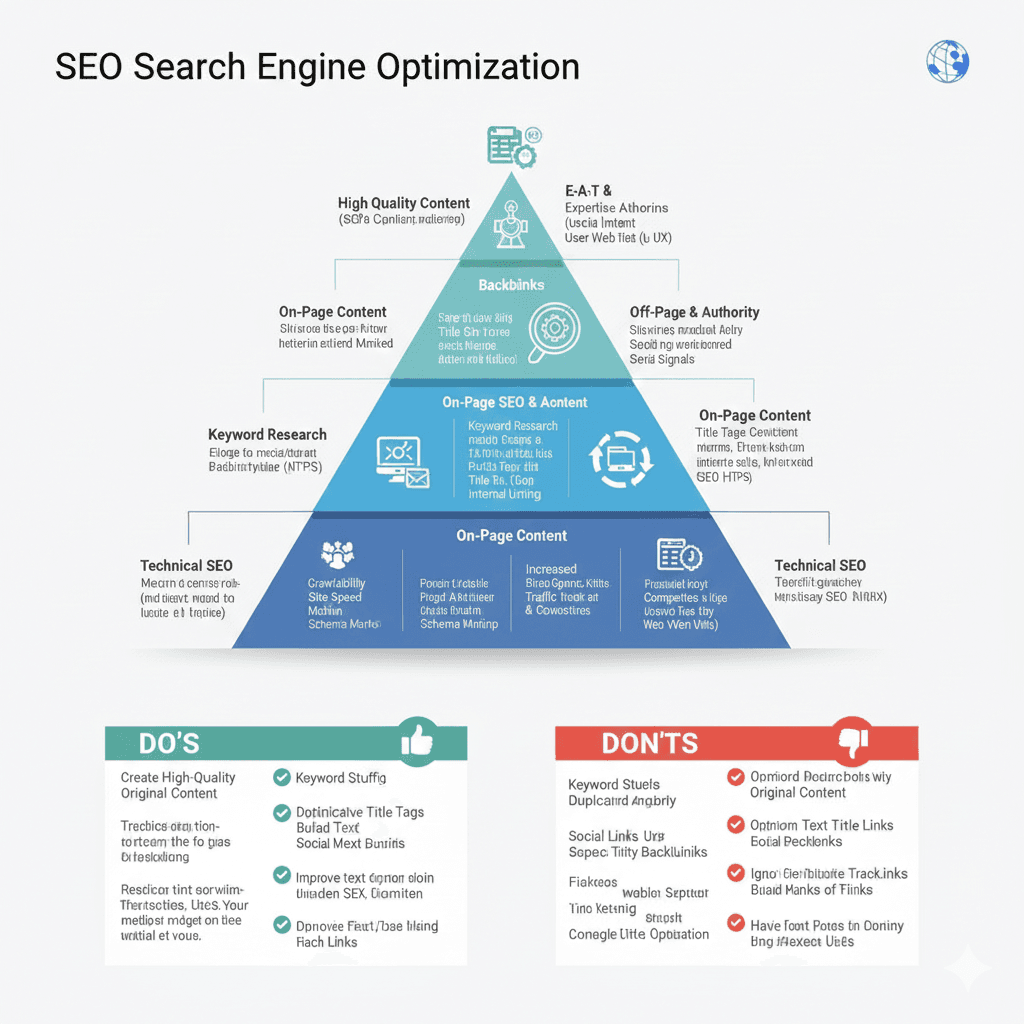
“SEO Search Engine Optimization” Infographic
The infographic uses a pyramid structure to organize the complexity of SEO, building from foundational technical requirements up to high-level authority.
1. The SEO Pyramid Structure
The pyramid illustrates the various layers of SEO:
- Apex (Authority): Focused on E-A-T (Expertise, Authoritativeness, Trust) and User Intent (UX).
- Top Layer (Off-Page/Authority): Relies on Backlinks and Off-Page & Authority (Secdt ng inretcoi ecd Sngailr, and user web list).
- Middle Layer (Content & Keywords): Covers On-Page Content (Title Tag/Meta, Internal Linking) and Keyword Research (measuring traffic, loss, and internal linking).
- Base Layer (Technical & Experience): Focuses on Technical SEO (Crawlability, Site Speed, Mobile, Schema Markup, HTTPs) and User Experience (Page Speed, Mobile, Site Usability).
2. SEO Best Practices: DO’s and DON’Ts
✅ DO’s (Best Practices)
- High-Quality Content: Create original, valuable, in-depth information.
- Technical SEO: Measure crawlability, site speed, and mobile readiness.
- Crawlability: Optimize Crawlability, Site Speed, Mobile, and Schema Markup.
- Descriptive Title Tags: Ensure descriptive titles for better visibility.
- Improve Text: Improve text flow and content to aid understanding.
❌ DON’Ts (Practices to Avoid)
- Keyword Stuffing: Do not over-use keywords.
- Duidten Text: Avoid duplicated content.
- Hidden Text/Links: Do not hide content or links.
- Broken Links: Avoid broken internal or external links.
- Spammy Backlinks: Do not engage in buying bad links.
Related Articles from Our Network
- Parse JSON C#: A Comprehensive Guide for Developers(json parser)
- OAuth JWT- Mastering OAuth 2.0 and JWT for Secure API Authentication(json web token)
- How to Easily Create a Mock JSON API Online for Faster Development & Testing(fake json)
- Compare 2 JSON: Mastering the JSON Compare Tool for Data Validation and Debugging(compare json)