Google Website Rank Checker- Track Your Keyword Rank and SEO Performance
A Google Keyword Rank Checker (or Google website rank checker) is an online tool that checks where your website appears on Google search results for specific keywords.1 It tells you the exact rank or ranking position your page holds when someone searches your targeted keyword. This essential checker tool is fundamental to modern SEO tracking.
For example:
If you search “online json compare” and your website appears at position 5, the rank checker will show Rank: 5.
Why Google Rank Checker and Rank Tracker Tools are Important
A rank checker helps you gain crucial insights into your website performance and SEO strategy. Using a rank tracker tool is vital because it allows you to:
- Track your website’s search performance and Google rankings.
- Understand which keywords are achieving a good keyword rank.
- Identify SEO improvements and opportunities
- Monitor keyword movements (up or down) over time.
- Analyze competitors’ rankings and compare your website rank.
Key Data You Can Check with a Rank Checker
The core function is the ranking check, but modern checker tools provide comprehensive keyword data:
- Website ranking position for the target Google keyword.
- Keyword search volume (how many people perform the keyword search).
- Competition difficulty.
- Keyword performance over time (tracking history).
- Mobile and desktop ranking.
- Ranking by country or location.
Benefits of Using a Google Keyword Rank Checker (Keyword Ranking)
Using a dedicated rank tracker like a Google rank checker offers significant advantages for achieving higher Google rankings:
- Helps boost your overall SEO strategy by focusing effort on high-potential keywords.
- Shows which keywords are most effective at driving organic traffic.
- Helps identify low-performing pages that need optimization.
- Saves time with automated ranking check and monitoring.
- Helps you improve content and optimization by revealing where you stand for a specific keyword ranking.
Who Uses a Google Website Rank Checker?
The Google website rank checker is an indispensable tool across the digital landscape:
- SEO experts who manage complex campaigns.
- Digital marketers focused on organic growth.
- Bloggers and content creators focused on keyword ranking.
- Website owners monitoring their domain authority.
- Businesses running online campaigns that rely on high Google rankings.
Final Summary
A Google Keyword Rank Checker is a powerful SEO tool that provides a vital ranking check by helping you track how your website ranks for specific keywords on Google. It is essential for monitoring your SEO performance, improving your keyword rank, and growing organic traffic by analyzing your ranking position and competition
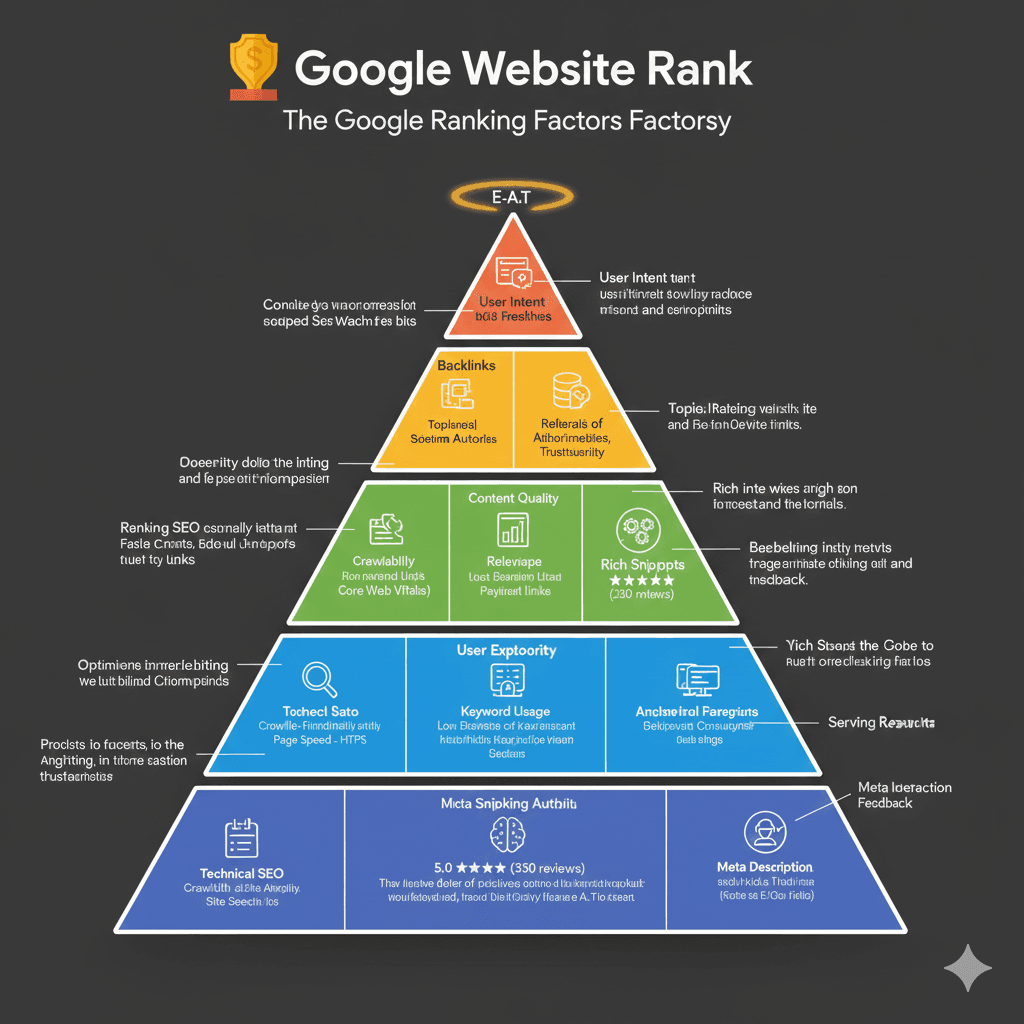
Content for “Google Website Rank” Infographic
The infographic uses a pyramid structure to illustrate the hierarchy and interdependency of ranking factors.
1. Foundation: Technical & Meta
This layer represents the basic requirements for a site to be indexed and understood by Google.
- Technical SEO: Focuses on Crawlability, Site Speed, and ensuring HTTPS.
- Meta Snipking Autbiib: Covers the Meta Description and relies on user reviews (e.g., 5.0 ★★★★★ (350 reviews)).
- Meta Description: Critical for communicating relevance (Note: acts as E-Oul tets).
2. User Experience
- Tocheed Satiy: Crawlability, Site Quality, and Page Speed—HTTPS.
- User Exptoortty: User Usage and Keyword Usage contribute to this layer.
- Ancheinal Faregouns: Behavioral/Searcher paths.
- Rich Snippets: Structured data that helps generate rich results (e.g., ratings, FAQs).
3. Content Quality & Trust
- Content Quality: Based on Crawlability (Core Web Vitals) and Relevance (Long-Tail Keywords, Used Payzeat Links).
- Trust/Authority: Built via Backlinks and Referrals of Authorities.
- Backlinks: Top-level authority and quality of inbound links.
- Topia: Relatiig vaiistt its and ito ictteits limits.
4. Apex: E-A-T & User Intent
- E-A-T (Expertise, Authoritativeness, Trustworthiness): The ultimate goal for quality content.
- User Intent: The content must satisfy the user’s query intent.
Related Articles from Our Network
- C JSON Parser: A Comprehensive Guide to Parsing JSON in C using cJSON and Jansson(json parser)
- How to Use com auth0 jwt jwt for JWT Verification and Creation in Java(json web token)
- How to Generate Fake JSON Data for Development and Testing(fake json)
- Online JSON Diff: How to Effectively Compare JSON Online(compare json)