The Difference Between Keyword Position vs. Actual Traffic
Many people assume that ranking high on Google automatically brings high traffic. In reality, keyword position, keyword rank, and actual traffic are very different SEO metrics. Understanding this difference helps you build a smarter ranking strategy.
Website owners often use tools like a keyword rank checker, SEO ranking checker, rank tracker, and SERP checker to monitor rankings. However, ranking data alone does not show how many real users actually click your website.
What Is Keyword Position? (Keyword Rank)
Keyword position, also known as keyword ranking, is the exact place your webpage appears in Google search results for a specific query.
Ranking positions are measured using tools such as keyword rank checkers, SERP checkers, SEO ranking checkers, and rank tracking tools. These tools help monitor ranking positions, tracked keywords, and ranking changes.
- Position #1 → First result
- Position #3 → Third result
- Position #10 → Last result on page one
Keyword position only shows where you rank, not how many people actually click your website.
What Is Actual Traffic?
Actual traffic refers to the number of real users who click your website from Google search results. Traffic depends on click-through rate (CTR), search intent, SERP layout, and competition.
Traffic is measured using Google Search Console, Google Analytics, and SEO tools like Semrush. Even a high ranking position does not guarantee traffic.
Why Keyword Rank Does Not Equal Actual Traffic
High Rank, Low CTR
Ranking number one does not guarantee clicks if your meta title is weak, competitors have better headlines, or SERP features reduce visibility. This is why ranking checks must include click data.
SERP Features Reduce Clicks
Google displays featured snippets, People Also Ask boxes, videos, and knowledge panels. These features often satisfy users without requiring a click.
Search Intent Mismatch
Sometimes Google answers the query directly in search results. For example, searching for “HTML full form” shows the answer instantly, resulting in zero clicks.
Ranking Differences Across Devices
Keyword position may vary between desktop and mobile. Rank tracking should always measure both to get accurate data.
Low Search Volume Keywords
A keyword may rank first but have very few searches. Even with strong ranking audits and keyword monitoring, traffic may remain low.
Conclusion
Keyword position shows where your page appears, while actual traffic shows how many users visit your site. To grow organic traffic, focus on search intent, CTR optimization, SERP features, and content quality. Combining keyword rankings with proper rank tracking and SERP monitoring leads to stronger SEO results.
FAQ
Why do I rank on page one but get no traffic? SERP features or stronger competitor titles may be taking the clicks.
Does ranking #1 guarantee traffic? No. Traffic depends on CTR, competition, and search intent.
Which is more important: ranking or traffic?Traffic is more valuable because it represents real users.
Why does Search Console show low clicks? Because impressions are high but users are not clicking your result.
Understanding the Search Disconnect
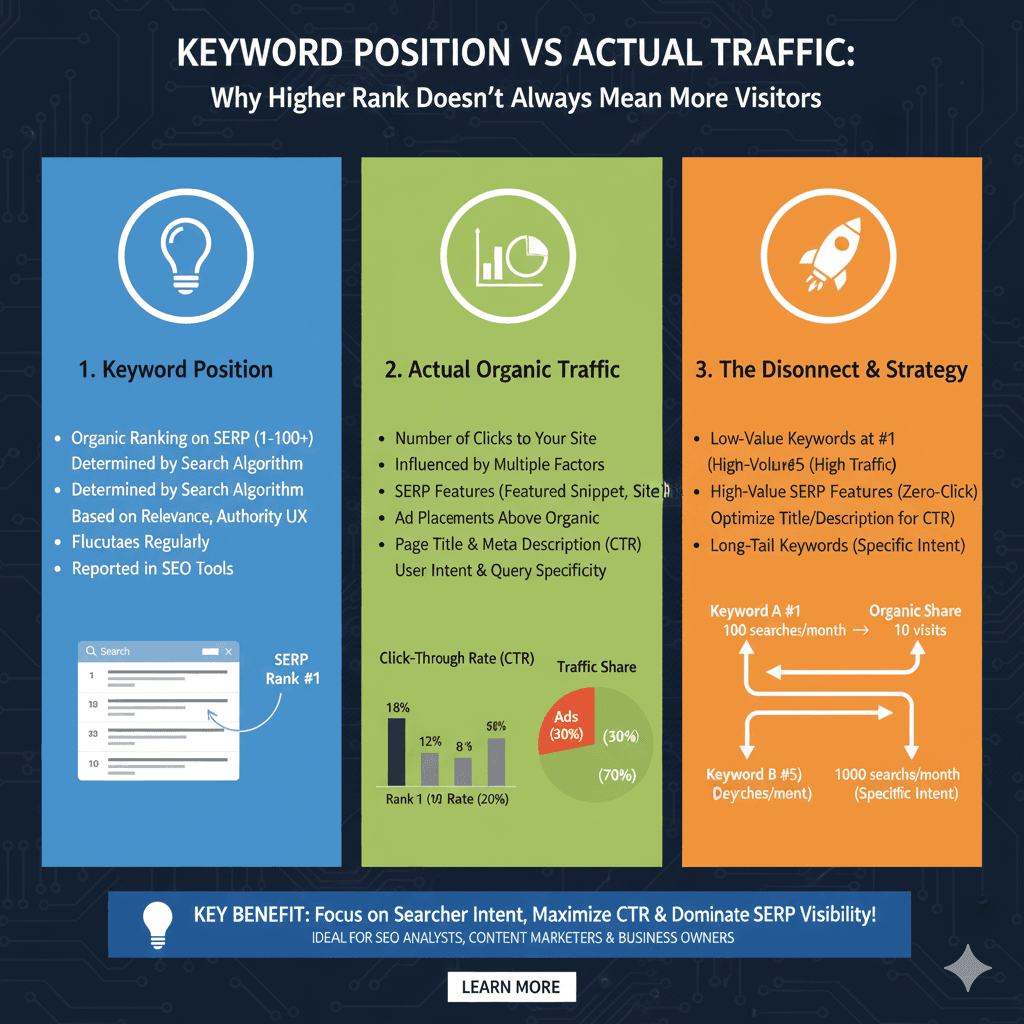
The graphic breaks down search performance into three analytical pillars to help marketers move beyond "vanity metrics" and focus on conversion-driving data:
1. Keyword Position (Blue)
This section defines the technical nature of search rankings:
- SERP Ranking: This is the organic position on a Search Engine Results Page, typically measured from 1–100+.
- Algorithmic Determination: Rankings are determined by search algorithms based on relevance, authority, and user experience (UX).
- Volatility: Positions fluctuate regularly and are primarily reported through SEO tracking tools.
2. Actual Organic Traffic (Green)
This module explains the factors that determine whether a high rank actually results in a visitor:
- Click-Through Rate (CTR): Traffic is the actual number of clicks to your site, heavily influenced by the Page Title and Meta Description.
- SERP Environment: Factors like Ads Placements above organic results and SERP Features (Featured Snippets, People Also Ask) can divert traffic even from the #1 spot.
- User Intent: The specificity of the query determines how likely a user is to click through to a specific result.
- Visual Data: A chart illustrates that while "Rank 1" might have a high CTR, ads can consume up to 30% of the total traffic share on the page.
3. The Disconnect & Strategy (Orange)
The final pillar provides a strategic comparison between volume and value:
- High-Volume vs. High-Value: A #1 rank for a low-volume keyword may only yield 10 visits, whereas a #5 rank for a high-volume "Long-Tail" keyword with specific intent could yield significantly more.
- Optimization Focus: Strategies should include optimizing titles and descriptions for CTR and targeting "Zero-Click" high-value SERP features.
- Searcher Intent: Prioritize keywords that align with what the user actually wants to achieve, rather than just high search volume.
Related Articles from Our Network
- BeautifulSoup JSON Parser-Combining BeautifulSoup and JSON for Web Scraping(json parser)
- What Is Okta JWT? (Beginner-Friendly Explanation)(json web token)
- What Is JSON Fake API? (Beginner-Friendly Explanation)(fake json)
- Diff JSON Online- The Ultimate Guide to Comparing JSON Files for Developers(compare json)