How to Optimize Your Website for Search and SEO: A Comprehensive Guide
In today’s digital landscape, getting your website seen by the right audience is paramount. This is where search and SEO (Search Engine Optimization) come into play. But how do you navigate this complex world to ensure your site ranks high on search engine results pages (SERPs)? This comprehensive guide will walk you through the essential steps to optimize your website for better visibility and increased organic search traffic. This involves detailed SEO work to improve your engine rankings on Google and other search engines.
Understanding Search and SEO Basics
Before diving into optimization techniques, let’s clarify what we mean by “search” and “SEO.” Search refers to the process users employ to find information, products, or services online using search engines like Google Search, Bing, or DuckDuckGo. SEO is the practice of increasing the quantity and quality of traffic to your website through organic search engine results.
SEO Work vs. Paid Search (PPC/SEM)
- SEO Work / Organic Search: Focuses on engine optimization tactics to earn free, natural traffic from search engines. This is the core of your search and seo strategy.
- Paid Search (PPC/SEM): Involves advertising using ads (like Google Ads or PPC) to buy visibility in search results. SEM (Search Engine Marketing) encompasses both SEO and PPC.
How to Implement On-Page SEO Strategies
On-Page SEO refers to all the optimizations you can perform directly on your website to improve its search engine ranking.
Keyword Research and Placement
- Use tools like Google Keyword Planner, Ahrefs, or SEMrush to find relevant keywords.
- Integrate primary and secondary keywords naturally into your content, headings, and meta descriptions.
- Avoid keyword stuffing, which can harm your ranking.
Crafting Compelling Meta Titles and Descriptions
- Meta Title: Keep it concise, include your primary keyword, and make it intriguing.
- Meta Description: Write a compelling summary that encourages clicks.
High-Quality SEO Content is King
- Create unique, well-researched content that answers user queries thoroughly.
- Regularly update your content to keep it fresh and relevant.
Mastering Technical SEO for Better Engine Rankings
Website Speed and Performance
- Optimize server response time.
- Leverage browser caching and use a CDN.
Ensuring Mobile-Friendliness
- Use a responsive web design that adapts to various screen sizes.
Setting Up Sitemaps and Robots.txt
- XML Sitemap: Submit an XML sitemap to Google Search Console to help search engines discover all your important pages.
- Robots.txt: Use this file to instruct crawlers which pages or sections of your site they should or shouldn’t access.
Building Authority with Off-Page SEO Work
High-Quality Backlinks
- Create exceptional content that others naturally want to link to.
- Reach out to authoritative sites in your niche for guest posting.
Optimizing for Local SEO
- Set up and optimize your Google My Business profile.
- Encourage customer reviews.
Monitoring and Adapting Your Search and SEO Strategy
Utilizing Google Analytics
- Track organic traffic, user behavior, bounce rate, and conversion rates.
Harnessing Google Search Console
- Check for crawl errors and security issues.
- Monitor keyword performance and click-through rates.
Conclusion
Mastering search and SEO is a continuous journey that requires dedication and a strategic approach. By consistently applying these on-page, technical, and off-page SEO work tactics, and regularly monitoring your performance, you can significantly improve your website’s visibility, attract more organic traffic, and ultimately achieve your online goals. Start implementing these “how-to” tips today and watch your search engine rankings climb!
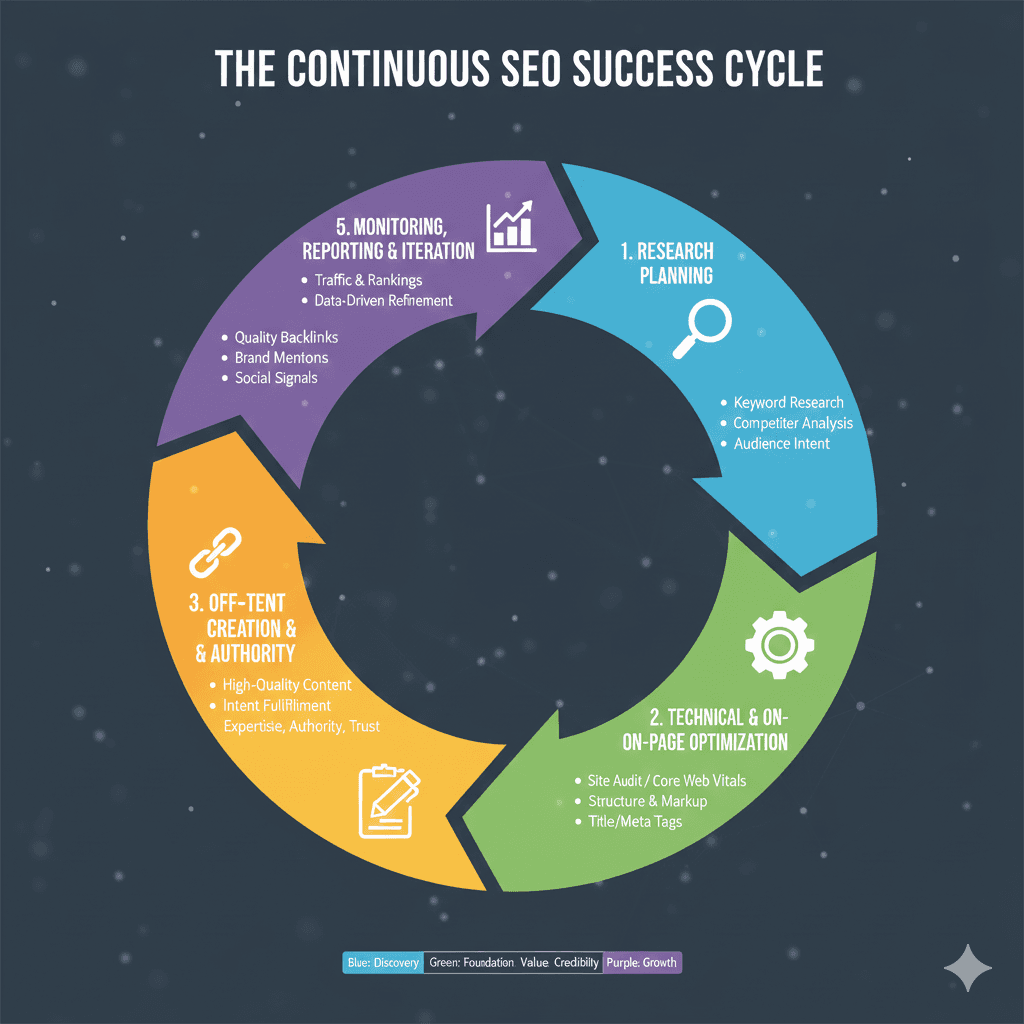
SEO Success Cycle
The cycle is color-coded and presented as a loop, emphasizing that SEO is an iterative process requiring constant monitoring and refinement.
1. 🔍 Research & Planning (Blue: Discovery)
- Keyword Research: Identifying the terms people use to find information.
- Competitor Analysis: Evaluating what other successful sites are doing.
- Audience Intent: Determining the user’s goal behind their search query.
2. ⚙️ Technical & On-Page Optimization (Green: Foundation)
- Site Audit / Core Web Vitals: Ensuring the website is healthy, fast, and stable.
- Structure & Markups: Implementing clean navigation and schema to help search engines understand content.
- Title / Meta Tags: Optimizing the snippets that appear in search results for better click-through rates.
3. ✍️ Off-Tent Creation & Authority (Orange: Value Credibility)
- High-Quality Content: Creating valuable and relevant material.
- Intent Fulfillment: Making sure the content directly answers user queries.
- Expertise, Authority, Trust: Demonstrating knowledge and trustworthiness (aligned with Google’s E-A-T/E-E-A-T guidelines).
4. 🔗 Authority & Link Building (Purple: Growth)
- Quality Backlinks: Acquiring links from reputable external websites.
- Brand Mentions: Encouraging mentions of the brand across the web.
- Social Signals: Promoting content on social media for visibility and traffic (though not a direct ranking factor, it aids discovery).
5. 📊 Monitoring, Reporting & Iteration (Purple: Growth)
- Traffic & Rankings: Tracking performance metrics to see what is working.
- Data-Driven Refinement: Using insights to adjust the strategy and improve underperforming areas.
Related Articles from Our Network
- How to Parse javascript json parse online-Your Online Guide(json parser)
- Mastering OAuth2 JWT and OAuth Authentication Introduction to OAuth2 JWT and Identity Security(json web token)
- How to Get Dummy Data REST API Testing and Development(fake json)
- JSON File Compare Online: The Ultimate JSON Compare Online and JSON Diff Guide for Files(compare json)