How to Master SEO Optimization: A Comprehensive Guide
In today’s digital landscape, effective SEO optimization is not just an advantage—it’s a necessity. If you’re looking to enhance your online visibility, attract more organic traffic, and outrank your competitors’ websites, then understanding the core principles of SEO is paramount. This guide will walk you through essential SEO strategy and tactics to help you achieve significant improvements in your search engine rankings.
Understanding the Fundamentals of SEO Optimization
Before diving into advanced techniques, it’s crucial to grasp the basics of SEO. Search Engine Optimization (SEO) is the process of improving the quality and quantity of website traffic to a site or a web page from search engines. SEO targets unpaid traffic (known as “organic” or “natural” results) rather than direct traffic or paid traffic (SEO PPC).
- Keyword Research: The foundation of any successful SEO optimization strategy. Identify keywords your target audience uses.
- On-Page SEO: Optimizing individual web pages to rank higher and earn more relevant traffic in search engines.
- Off-Page SEO: Actions taken outside of your own website to impact your ranking within search engine results pages (SERPs).
- Technical SEO: Ensuring search engine crawlers can efficiently access, crawl, and index your website.
Keyword Research: The Heart of Effective Search Optimization
How to perform effective keyword research is often the first step in any search optimization journey. It involves identifying the keywords and phrases your target audience uses when searching for information related to your content or business.
- Brainstorm broad topics relevant to your niche.
- Use a tool for keyword research (Google Keyword Planner, SEMrush, Ahrefs).
- Analyze search volume and competition for target keywords.
- Identify long-tail keywords for specific queries.
On-Page SEO Optimization Techniques
Optimizing your actual web pages is critical for telling search engines what your content is about. Here’s how to implement effective on-page SEO optimization:
- Title Tags: Include your primary keyword near the beginning.
- Meta Descriptions: Craft compelling descriptions that encourage clicks. Include keywords naturally. These meta tags are a key SEO factor.
- Header Tags (H1,H2, H3): Structure your content logically. Incorporate keywords naturally into the structure.
- Content Quality: Create high-quality, comprehensive, and unique content that provides value to your readers.
- URL Structure: Keep URLs short, descriptive, and keyword-rich.
- Internal Linking: Link to other relevant pages on your site to improve navigation and distribute link equity.
Off-Page SEO: Building Authority and Trust
- Link Building: Acquire high-quality backlinks from reputable websites.
- Social Media Marketing: While not a direct ranking factor, social signals can increase content visibility and drive traffic.
- Local SEO: Optimize your Google My Business profile.
Technical SEO: Best Practices for Engine Optimization
- Site Speed: Optimize your website for fast loading times.
- Mobile-Friendliness: Ensure your site is responsive and provides a great user experience on all devices.
- XML Sitemaps: Submit an XML sitemap to search engines.
- Robots.txt: Use this file to instruct search engine crawlers which parts of your site they should or shouldn’t access.
Conclusion: Continuous SEO Optimization is Key
Mastering SEO optimization is an ongoing process that requires continuous effort and adaptation to algorithm changes. By consistently applying these engine optimization strategies—from thorough keyword research to technical seo fine-tuning—you can significantly improve your website’s performance in search engine results and achieve sustainable growth in organic traffic. Regularly perform seo audits to monitor your seo content and site structure. A dedicated seo specialist often uses an audit tool for this purpose. Start implementing these “how to” tips today and watch your organic traffic soar!
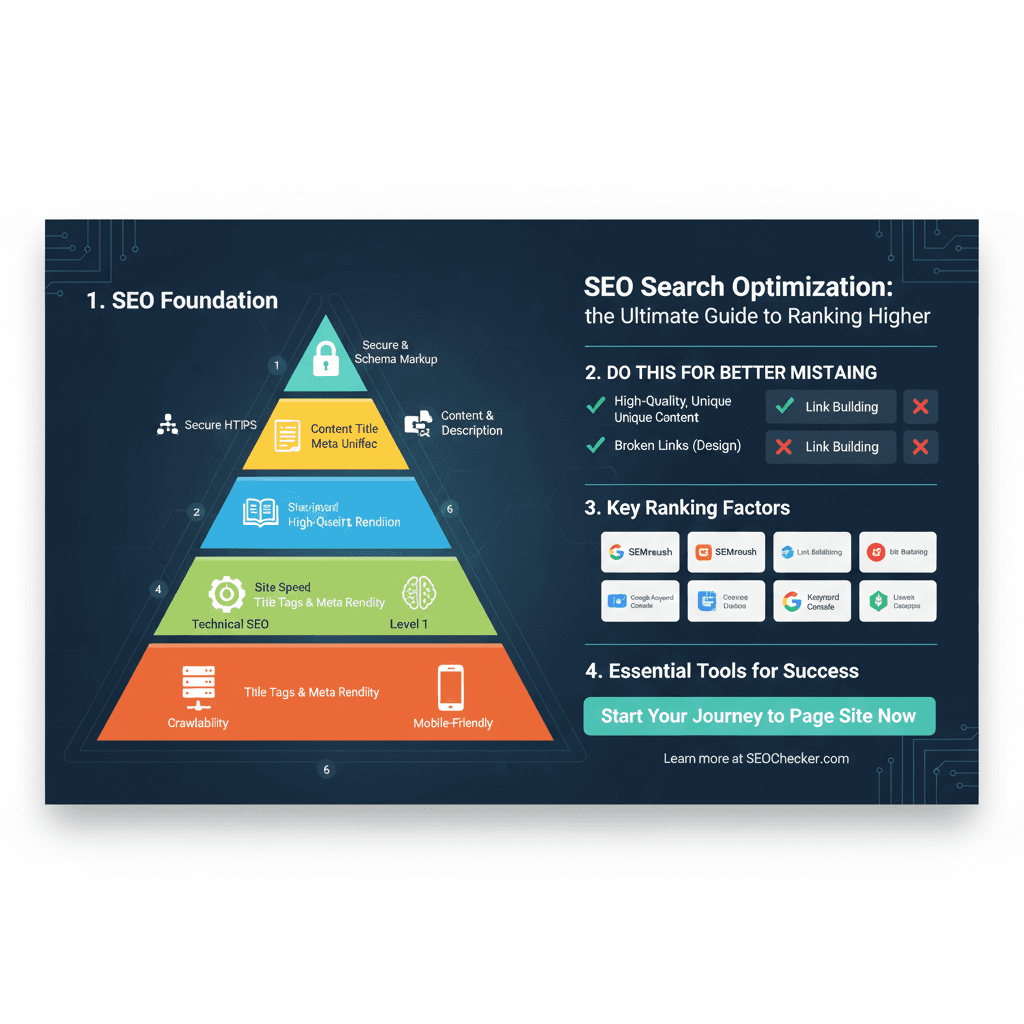
SEO Foundation Pyramid
This infographic breaks down the hierarchy of search engine optimization, showing that foundational elements must be established before higher-level strategies are effective.
1. SEO Foundation (The Pyramid) 🧱
The pyramid illustrates the strategic hierarchy of optimization factors.
| Level | Factors Included | Key Concepts |
|---|---|---|
| Level 1 (Base) | Crawlability, Mobile-Friendly | The site must be accessible to search engines and users on all devices. |
| Level 3 | Content Site Speed and High-Quality Content | Focuses on user experience and providing trustworthy, relevant content. |
| Level 5 | Secure HTTPS Sosse & Schema Partitud and Schema Markup | Ensures security and enhances listing visibility through rich snippets. |
| Other Factors | Technical SEO, Title Tags & Meta Rendity, Content Title Meta Unifac | These structural elements are integrated throughout the hierarchy. |
2. DO THIS FOR BETTER MISTAING (Checklist) ✅
- High-Quality, Unique Content.
- Igoridtrre Titge & Thin Islacliks.
- Duplicate to Speed.
- Broken Links (Design).
- Missing Alt Text on Images.
- Gedicate a Thin Qontent.
3. Key Ranking Factors 🔑
- SEMreush.
- Link Building.
- Mobile-Friendly Planner.
- Secure Convection.
- Majestic SEO.
4. Essential Tools for Success 🛠️
- Stacikinks.
- Google-Friendly Design.
- Google Keyword Consolel.
- Rejestic SEO Imetress.
Related Articles from Our Network
- How to Parse geojson parser- A Comprehensive Guide for Developers(json parser)
- How to Implement node jwt Authentication in Node.js Applications(json web token)
- How to Use Dummy API JSON for Faster Development and Testing: Leveraging Fake APIs, JSON, and Mockaroo(fake json)
- How to Easily Compare Two JSON Online: A Comprehensive Guide(compare json)