SEO Search Engine Optimization: Mastering the Search Engine for Traffic
Search Engine Optimization (SEO) is the art and science of improving your website’s visibility when people search for products or services related to your business on Google, Bing, and other search engines. The goal of SEO is to rank higher in search results, driving more organic traffic (unpaid traffic) to your site.
If you’re wondering “How to” make your website stand out, understanding the fundamentals of SEO search engine optimization is your first step. It’s not just about getting traffic; it’s about getting the right traffic – users who are actively looking for what you offer. This is the core of successful search optimization.
Key Pillars of Effective SEO Strategy and SEO Work
To successfully optimize your site for search engines, you need to address several core areas, defining a robust SEO strategy:
On-Page SEO: The Foundation of SEO Search Engine Success
Optimizing individual web pages to rank higher and earn more relevant traffic in search engines. This includes content, keywords, title tags, meta descriptions, and image alt text.
Technical SEO: Ensuring a Healthy Site
Ensuring a website meets the technical requirements of modern search engines with the goal of improved organic rankings. This is vital SEO work covering site speed, mobile-friendliness, crawlability, sitemaps, and structured data.
Off-Page SEO: Building Authority and Trust
Actions taken outside of your own website to impact your rankings within search engine results pages SERPs. The most prominent factor here is backlinks from other reputable websites, which build authority.
How to Implement SEO Strategies for Search Engines
The implementation of any successful SEO strategy is systematic:
1. Keyword Research: The Foundation of SEO Search Engine Success
Before you write a single word, you need to know what your audience is searching for (search queries). Keyword research involves finding relevant terms and phrases that users type into search engines. SEO tools like Google Keyword Planner, Ahrefs, or SEMrush can help you identify high-volume, low-competition keywords.
- Think like your customer: What would they search for?
- Focus on long-tail keywords (e.g., “how to improve local seo for small business”) which are more specific and often have higher conversion rates.
- Analyze competitor keywords to find opportunities.
2. On-Page Content Optimization
Once you have your keywords, it’s time to integrate them naturally into your content.
- Compelling Titles & Meta Descriptions: Your title tag and meta description are crucial for click-through rates. Include your primary keyword and make them engaging.
- High-Quality Content: Create valuable, informative, and engaging content that answers user queries thoroughly. Aim for depth and originality in every article.
- Keyword Placement: Include your primary keyword in the first paragraph, in headings H2,H3, and naturally throughout the text. Don’t keyword stuff!
- Image Optimization: Use descriptive alt text for images, incorporating keywords where relevant.
3. Technical SEO Essentials
A technically sound website is crucial for search engine crawlability and user experience.
- Site Speed: Optimize images, leverage browser caching, and use a CDN to ensure fast loading times. The Google engine prefers fast sites.
- Mobile-Friendliness: Ensure your website is responsive and provides a seamless experience on all devices. Google uses mobile-first indexing.
- XML Sitemaps: Submit an XML sitemap to Google Search Console to help search engines discover and crawl all your important pages.
- Robots.txt: Use a robots.txt file to guide search engine bots on which parts of your site they should or shouldn’t crawl.
- Secure (HTTPS) Site: Implement SSL TLS encryption HTTPS for security. This is a ranking factor.
4. Building High-Quality Backlinks (Off-Page SEO)
Backlinks are votes of confidence from other websites to yours. The more high-quality, relevant backlinks you have, the more authoritative your site appears to search engines.
- Guest Blogging: Write articles for other reputable websites in your niche, including a link back to your site.
- Broken Link Building: Find broken links on other websites and suggest your relevant content as a replacement.
- Promote Your Content: Share your content on social media and reach out to influencers or industry leaders who might find it valuable and link to it.
Monitoring and Adapting Your SEO Strategy
SEO is not a one-time task; it’s an ongoing process and continuous SEO work. Use tools like Google Analytics and Google Search Console to monitor your website’s performance, track keyword rankings, identify crawl errors, and understand user behavior. Regularly analyze your data to adapt your SEO strategy and stay ahead of algorithm updates. Publications like Search Engine Land and Moz provide excellent resources for keeping up with the latest SEO developments.
Conclusion
Mastering SEO for search engines is a journey that requires continuous effort, learning, and adaptation. By focusing on robust keyword research, creating high-quality content, ensuring a technically sound website, and building authoritative backlinks, you can significantly boost your visibility and drive valuable organic traffic. Remember, the goal of your search engine optimization and SEO work is to provide the best possible search experience and most relevant information to your users, and search engines will reward you for it.
Would you like to search for the latest algorithm updates from Google that might affect your current SEO strategy?
That is an excellent transition! The previous step of optimizing your blog content is essential for a strong SEO strategy. Now that you’ve asked about the latest updates, I can provide you with the most current information for December 2025, directly complementing your article’s advice.
🚨 Google Algorithm Updates (Latest as of December 2025)
The SEO world in 2025 has seen significant shifts, with Google rolling out multiple major core updates, most recently in June and August, and showing continuous volatility in November and December.
The overarching theme for your SEO strategy is a relentless focus on user value and trust.
1. Quality Content Evaluation: E-E-A-T and Authenticity
Google continues to refine how it assesses content quality, focusing on E-E-A-T (Experience, Expertise, Authoritativeness, and Trustworthiness).
Actionable Insight for Your Content: Your content must be genuinely helpful, authoritative, and demonstrate real-world experience. If you write about a product, you should show that you have actually used it. Low-quality, thin, or purely AI-generated spam content is actively being penalized and removed from the index.
The Key Takeaway: Update your content to ensure it is comprehensive, informative, and backed by credible sources.
2. Technical SEO Priority: Core Web Vitals
Google continues to prioritize Core Web Vitals (CWV) as crucial metrics for User Experience (UX). Sites that fail to meet these benchmarks are seeing drops in rankings.
| Metric | What It Measures | Target Score | Optimization Focus |
|---|---|---|---|
| LCP (Largest Contentful Paint) | Page Loading Performance | $< 2.5$ seconds | Optimize images, use next-gen formats (WebP), and leverage a CD. |
| FID (First Input Delay) | Interactivity & Responsiveness | $< 100$ ms | Defer non-critical JavaScript. |
| CLS (Cumulative Layout Shift) | Visual Stability | $\le 0.1$ | Define image/video dimensions upfront to prevent elements from shifting. |
Actionable Insight for Your Site: Improve site speed and mobile performance. Use tools like Google Search Console to check your CWV report.
3. The Threat to Off-Page SEO: Spam and Link Penalties
Google has intensified its efforts to combat manipulative link-building.
New Policies: Google introduced new spam policies in 2025, explicitly targeting Scaled Content Abuse, Expired Domain Abuse, and Site Reputation Abuse.
Actionable Insight for Backlinks: Stick strictly to ethical, organic link-building strategies. Avoid buying links or relying on bots. Focus on building high-quality, relevant backlinks from reputable sources (authority).
4. Search Behavior Shifts: Zero-Click and AI Overviews
With the integration of AI Overviews and rich snippets, more user queries are resulting in “zero-click searches” (where the answer is provided directly on the SERP
Actionable Insight for Your Content: Structure your content into clear, concise Q A formats and bulleted lists to be chosen as a featured snippet or AIOverview source. This is crucial for maintaining visibility even if the user doesn’t click your link.
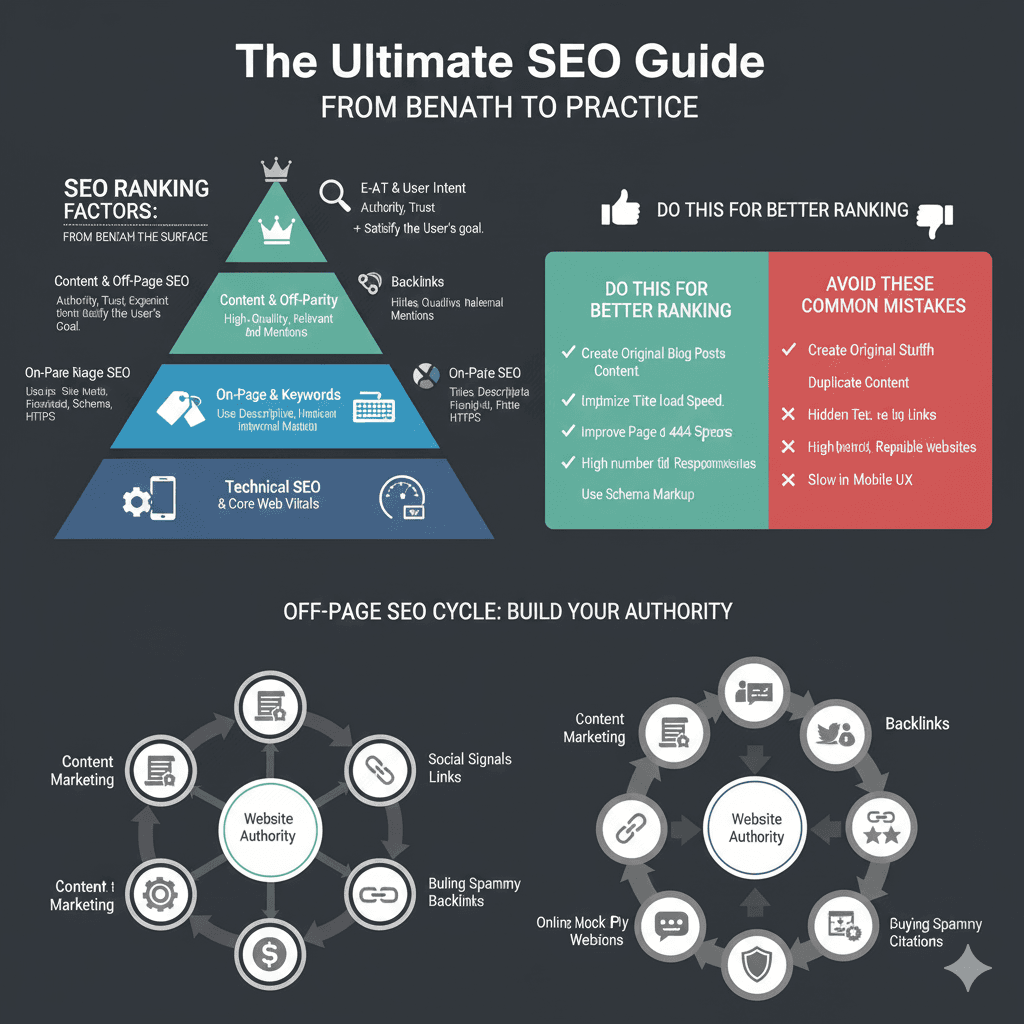
Ranking Factors Hierarchy
The pyramid illustrates the various layers of SEO, building from foundational technical requirements up to high-level authority.
| Layer | Focus | Key Factors |
|---|---|---|
| Apex (Trust) | E-A-T (Expertise, Authoritativeness, Trust) | Expertise Authoritativeness (E-A-T) & User Intent (UX). |
| Upper Layer | Authority & Off-Page | Backlinks, Off-Page & Authority (Social Signals), and High Quality Content. |
| Middle Layer | On-Page & Content | Keyword Research, On-Page Content (Title Tags, Meta Descriptions, Internal Linking), and Technical SEO (Site Speed, Mobile). |
| Base (Foundation) | Technical SEO | Crawlability, Site Speed, Mobile readiness, and Schema Markup. |
✅ SEO Best Practices: DO’s and DON’Ts
This section provides a quick, actionable guide for optimizing a website.
DO’s (Best Practices)
- Create High-Quality Original Content.
- Ensure Technical SEO (crawlability, site speed, mobile readiness).
- Use Descriptive Title Tags.
- Improve text flow and content to aid understanding.
DON’Ts (Practices to Avoid)
- Avoid Keyword Stuffing.
- Do not use Duplicated Content.
- Avoid Hidden Text or Hidden Links.
- Do not acquire Spammy Backlinks (buying bad links).
Related Articles from Our Network
- Fastest JSON Parser Python for Peak Performance: Why Orjson and Msgspec are the Top Contenders(json parser)
- How to Implement jwt token node js Applications(json web token)
- Dummy API for JSON Data: Unlocking Efficient Development(fake json)
- How to Compare Two JSON Files Effectively: A Comprehensive Guide(compare json)