How to Master Search Engine Marketing (SEM) for Explosive Business Growth
How to Master Search Engine Marketing (SEM) for Explosive Business Growth
In today’s Competitive digital scape, getting your business seen by the right audience at the right time is crucial. This is where Search Engine Marketing (SEM) comes into play. If you’re wondering “How to” effectively leverage SEM to propel your business forward, you’ve come to the right place. This guide will walk you through the essentials, strategies, and best practices to master SEM and achieve significant growth.
What is Search Engine Marketing (SEM)?
Search Engine Marketing (SEM) is a broad term that encompasses strategies used to increase the visibility of a website in search engine results pages (SERPs). While often confused with Search Engine Optimization (SEO), SEM primarily focuses on paid advertising efforts, commonly known as Pay-Per-Click (PPC) campaigns.
The goal of SEM is simple: to drive targeted traffic to your website by appearing prominently on search engines like Google and Bing when users search for keywords relevant to your business.
Key Components of an Effective SEM Strategy
An impactful SEM strategy is built upon several interconnected components. Understanding each will help you craft campaigns that yield results.
1. Pay-Per-Click (PPC) Advertising
PPC is the backbone of most SEM efforts. Platforms like Google Ads (formerly Google AdWords) and Microsoft Advertising (Bing Ads) allow you to bid on keywords. When a user searches for your chosen keyword, your ad may appear at the top or bottom of the SERP. You only pay when someone clicks on your ad.
2. Keyword Research
This is the foundation of any successful SEM campaign. You need to identify the words and phrases your target audience uses when searching for products or services like yours.
- Long-tail keywords often have lower competition and higher conversion rates.
- Analyze competitor keywords to find new opportunities.
- Use tools like Google Keyword Planner, SEMrush, or Ahrefs.
3. Compelling Ad Copywriting
Your ad copy is your first impression. It needs to be concise, relevant, and persuasive to entice users to click. Focus on:
- Highlighting unique selling propositions (USPs).
- Including a clear call-to-action (CTA).
- Matching the ad copy to the user’s search intent.
- Utilizing ad extensions (sitelinks, callouts, structured snippets) to provide more information.
4. Landing Page Optimization (LPO)
After clicking your ad, users land on a specific page. This landing page must be highly relevant to the ad and the user’s search query. A well-optimized landing page should:
- Have a clear, compelling headline.
- Provide relevant content that fulfills the promise of the ad.
- Feature a prominent call-to-action.
- Be mobile-friendly and load quickly.
5. Bid Management and Budget Allocation
Effective bid management ensures you’re getting the most out of your budget. You can set manual bids or use automated bidding strategies provided by advertising platforms. Regularly monitor your campaign performance to adjust bids for optimal return on investment (ROI).
6. Tracking, Analysis, and Optimization
SEM is an iterative process. You must continuously track your campaign performance using tools like Google Analytics. Analyze key metrics such as:
- Click-Through Rate (CTR)
- Cost-Per-Click (CPC)
- Conversion Rate
- Return on Ad Spend (ROAS)
Use these insights to optimize your keywords, ad copy, bids, and landing pages for better results.
How to Create Your First SEM Campaign: A Step-by-Step Guide
Ready to dive in? Follow these steps to set up your first effective SEM campaign.
Step 1: Define Your Goals
What do you want to achieve? (e.g., increase website traffic, generate leads, boost online sales). SMART goals (Specific, Measurable, Achievable, Relevant, Time-bound) are essential.
Step 2: Conduct Thorough Keyword Research
As discussed, find both broad and long-tail keywords relevant to your business and user intent.
Step 3: Structure Your Campaigns and Ad Groups
Organize your keywords into logical ad groups based on themes. Each ad group should contain highly relevant keywords and specific ads.
Campaign A (e.g., "Running Shoes")
Ad Group 1: "Men's Running Shoes"
Ad Group 2: "Women's Running Shoes"
Ad Group 3: "Trail Running Shoes"
Step 4: Craft Compelling Ad Copy
Write several variations of ad copy for each ad group. Test different headlines, descriptions, and calls-to-action to see what resonates best with your audience.
Step 5: Design and Optimize Landing Pages
Ensure that each ad directs users to the most relevant and optimized landing page. The landing page experience is crucial for conversion.
Step 6: Set Your Budget and Bids
Determine your daily or monthly budget. Start with manual bidding to understand costs, then explore automated strategies once you have sufficient data.
Step 7: Launch and Monitor
Once your campaign is live, closely monitor its performance. Don’t set it and forget it! Regular checking is key.
Step 8: Analyze and Optimize Continuously
Use the data you collect to make informed decisions. A/B test different elements, refine your keywords (add negative keywords to block irrelevant searches), and adjust your bids.
Best Practices for SEM Success
Mobile-First Approach: Ensure your ads and landing pages are fully optimized for mobile devices, as a significant portion of searches happen on smartphones.
A/B Testing: Constantly test different ad copies, landing page elements, and bidding strategies to improve performance.
Ad Extensions: Utilize all relevant ad extensions to provide more information and increase ad visibility.
Negative Keywords: Add negative keywords to prevent your ads from showing for irrelevant searches, saving you money and improving targeting.
Quality Score: Focus on improving your Google Ads Quality Score, which is influenced by ad relevance, CTR, and landing page experience. A higher Quality Score can lead to lower CPCs and better ad positions.
Competitor Analysis: Regularly review what your competitors are doing in their SEM campaigns.
Conclusion
Mastering Search Engine Marketing is an ongoing journey that requires dedication, continuous learning, and adaptation. By understanding the core components, systematically building your campaigns, and committing to relentless optimization, you can harness the immense power of SEM to drive highly targeted traffic, increase conversions, and achieve explosive growth for your business. Start implementing these strategies today and watch your online presence flourish!
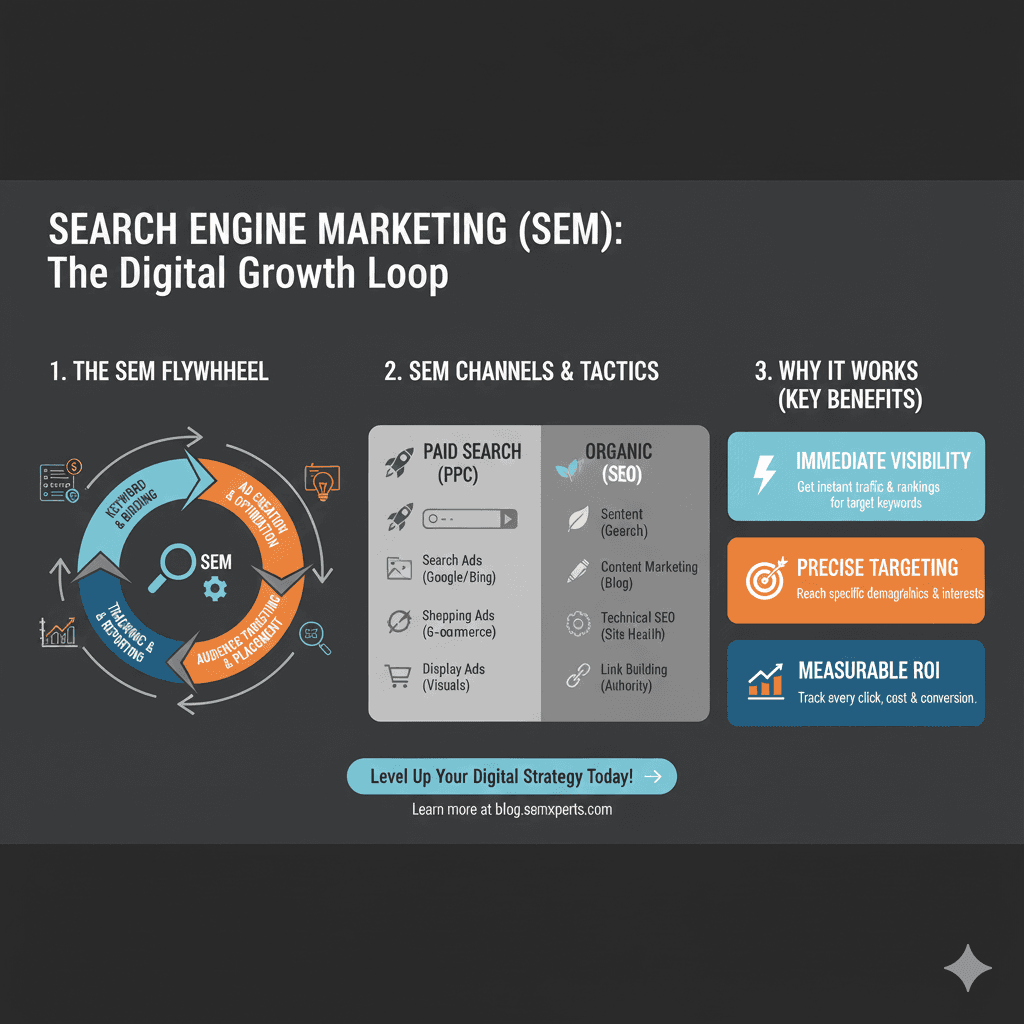
Engine Marketing (SEM) Infographic
The infographic is divided into three key sections: the continuous process (Flywheel), the channels used, and the advantages.
1. The SEM Flywheel (The Digital Growth Loop) 🔄
This circular diagram illustrates the continuous, iterative process that drives SEM success.
Keyword & Bidding: The process starts here, focusing on identifying the right keywords and setting competitive bids for paid ads.
Ad Creation & Optimization: Developing and refining ad copy, creatives, and landing pages.
Audience Targeting & Placement: Defining specific demographics and contexts where ads will appear.
Tracking & Reporting: Measuring the results (clicks, conversions, cost) to inform the next cycle of bidding and optimization.
2. SEM Channels & Tactics (PPC vs. SEO) 📊
SEM encompasses both Paid and Organic strategies, which are split into two main columns.
Paid Search (PPC)
Search Ads (Google/Bing): Bidding on keywords to appear at the top of search results.
Shopping Ads (E-commerce): Product listing ads typically used by online retailers.
Display Ads (Visuals): Banner ads shown across the Google Display Network or other partner sites.
Organic (SEO)
Content Marketing (Blog): Creating high-quality, relevant content to naturally rank higher.
Technical SEO (Site Health): Optimizing the website’s speed, crawlability, and structure.
Link Building (Authority): Acquiring high-quality backlinks to establish authority.
3. Why It Works (Key Benefits) 🎯
SEM provides powerful advantages for digital growth.
Immediate Visibility: SEM (specifically PPC) allows businesses to get instant traffic & rankings for target keywords.
Precise Targeting: Ability to reach specific demographics & interests with advertising efforts.
Measurable ROI: SEM tools allow marketers to track every click, cost & conversion, providing clear return on investment data.