What Are Search Engines and Why They Matter
Search engines are sophisticated software systems designed to retrieve information from the web based on user queries. When users search for content, products, or services, engines like Google search, Bing, and Yahoo search analyze billions of web pages to show the most relevant search results.
Modern search engines focus on:
- High-quality, people-first content that demonstrates E-E-A-T (Experience, Expertise, Authoritativeness, Trust).
- Exceptional User experience, page speed, and mobile usability (Core Web Vitals).
- Privacy and security features.
Alternative search engines such as DuckDuckGo, Brave, and Qwant are growing in popularity because they offer private search and enhanced privacy features for users who want more control over their data.
Search Engine Optimization and Search Optimization Explained
Search engine optimization (SEO) is the process of improving your website so that it ranks higher in search engine results. Search optimization focuses on aligning your content, structure, and technical setup with how search engines crawl and index web pages.
Effective SEO helps:
- Increase organic traffic and improve visibility across search engines.
- Reach users searching for relevant information on the web.
- Reduce dependency on paid search ads and ads platforms.
On-Page SEO for Search Engines
On-page SEO ensures your website content is optimized for both users and engines.
Key elements include:
- Creating valuable content focused on search engines, web search, and user needs.
- Using keywords like google, duckduckgo, and alternative search naturally within the content, titles, and headings.
- Optimizing readability across browser platforms like Chrome.
Technical SEO and Website Performance
Technical SEO ensures that search engine software can easily crawl and index your website.
Important factors:
- Fast loading speed for better user experience.
- Mobile-friendly design for all users.
- Clear site structure for better search results.
- Optimized pages for images, videos, and maps (multimodal search).
Search engines like Google and Bing prioritize websites that offer smooth performance across devices and browsers.
Alternative Search Engines and Private Search Options
While Google still dominates web search, many users are turning to alternative search engines for privacy and unique features.
| Search Engine | Key Feature / Focus | Ad Model | Personalization/Tracking |
| Google Search | Unmatched size of index, highly personalized results, integrated with maps, videos, and services. | Highly personalized ads based on extensive user profiling. | Extensive tracking for personalized results and ads. |
| DuckDuckGo Search | Strict private search policy, zero tracking. Uses Bing and its own DuckDuckBot index. | Contextual search ads based only on the current search query. | No tracking, results are the same for all users (no filter bubble). |
| Qwant | European privacy focus, adheres to GDPR. Uses its own index supplemented by Bing. | Non-personalized ads. | No tracking or storage of search history. |
| Brave Search | Independent index, built-in browser privacy. Offers Goggles (customizable results) and AI summaries. | Ads optional and privacy-respecting. | No tracking. |
| Startpage | Provides Google search results in total privacy (acts as a privacy proxy). | Non-personalized ads. | No tracking. |
Search Ads, Organic Results, and User Intent
Search engines display a mix of search ads and organic SEO results. While ads can bring quick traffic, long-term success depends on strong SEO. The rise of AI Overviews and Generative AI in search results means focusing on content that directly and expertly answers user intent is more important than ever.
Key Ranking Signals in 2025: Focus on E-E-A-T
To boost rankings across search engines, particularly Google, the dominant engine, you must focus on the four pillars of E-E-A-T:
- Experience: Demonstrate first-hand experience with the topic.
- Expertise: Show the creator’s depth of knowledge and credentials.
- Authoritativeness: Build the overall reputation of your search site or brand.
- Trustworthiness: Ensure site security (HTTPS), accuracy, and transparency.
Search engines reward websites that deliver value, accuracy, and a positive browsing experience, consistently cracking down on manipulative tactics and low-quality, scaled content using AI systems like SpamBrain.
Conclusion: Optimize for Search Engines and Long-Term Growth
Optimizing your website for search engines, including Google, DuckDuckGo, and Qwant, is essential for sustainable online growth. By combining strong search engine optimization (SEO), quality content that proves E-E-A-T, technical improvements, and awareness of alternative search platforms, you can improve visibility, attract users, and rank higher in search results.
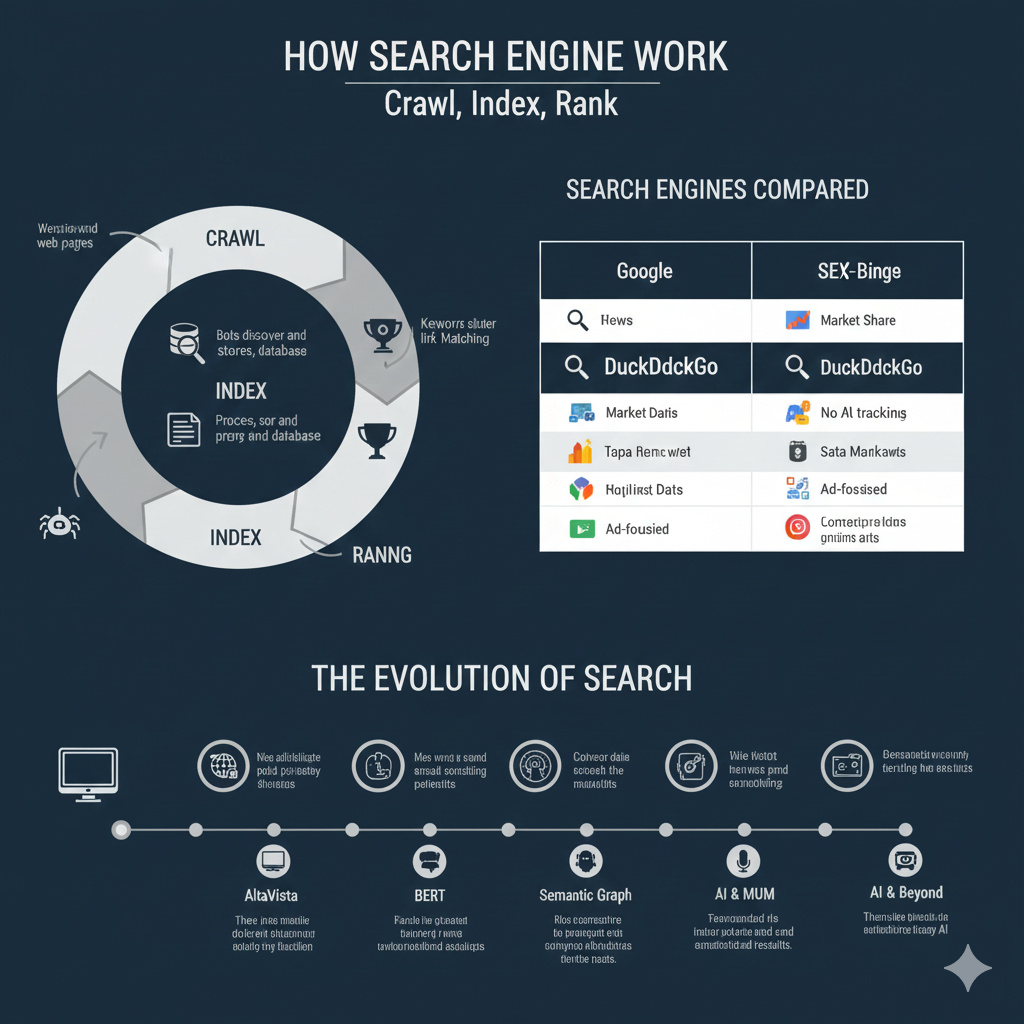
How Search Engines Work (Core Workflow)
The graphic uses a cyclical diagram to illustrate the three main stages of how search engines process information:
- Crawl: Bots discover and store web pages.
- Index: Pages are processed, sorted, and prepared in a database.
- Ranking: Algorithms perform keyword matching and rank the indexed results.
🌐 Search Engines Compared
A table contrasts Google and another search engine, SEX-Binge (likely a placeholder for Bing, given the context of search engines), and DuckDckGo:
| SEX-Binge | DuckDckGo | |
| News | Market Share | No AI tracking |
| Market Data | Data Markaws | |
| Hotlinks Data | ||
| Ad-focused | Ad-focused | |
| Content provides |
📈 The Evolution of Search
A timeline highlights key milestones in the development of search technology:
- AltaVista: Described as “No reliable [information] for credibility”.
- BERT: Focuses on natural language processing and understanding sentence context.
- Semantic Graph: Concerned with conveying accurate data and comprehending entities.
- AI & MUM: Facilitates inter-sentence and cross-modal understanding and results.
- AI & Beyond: Emphasizes thematic queries and seamless AI integration.
learn for more knowledge
Json parser-> How to Find the Fastest JSON Parser for Peak Performance – json parse
Json web token ->Spring Security JWT: Your Comprehensive Guide to JSON Web Tokens – json web token
Json Compare ->Compare Two JSON Files Online Easily and Accurately – online json comparator
Fake Json –>Dummy API for JSON Data: Unlocking Efficient Development – fake api
Leave a Reply